

Full Service
Plans
Comprehensive roadmap execution from infrastructure to identity.
Explore PlansAI & Automation
n8n is changing how businesses build AI-powered workflows. Explore what AI agents can automate today, where human control still matters, and what the future of AI automation may look like.
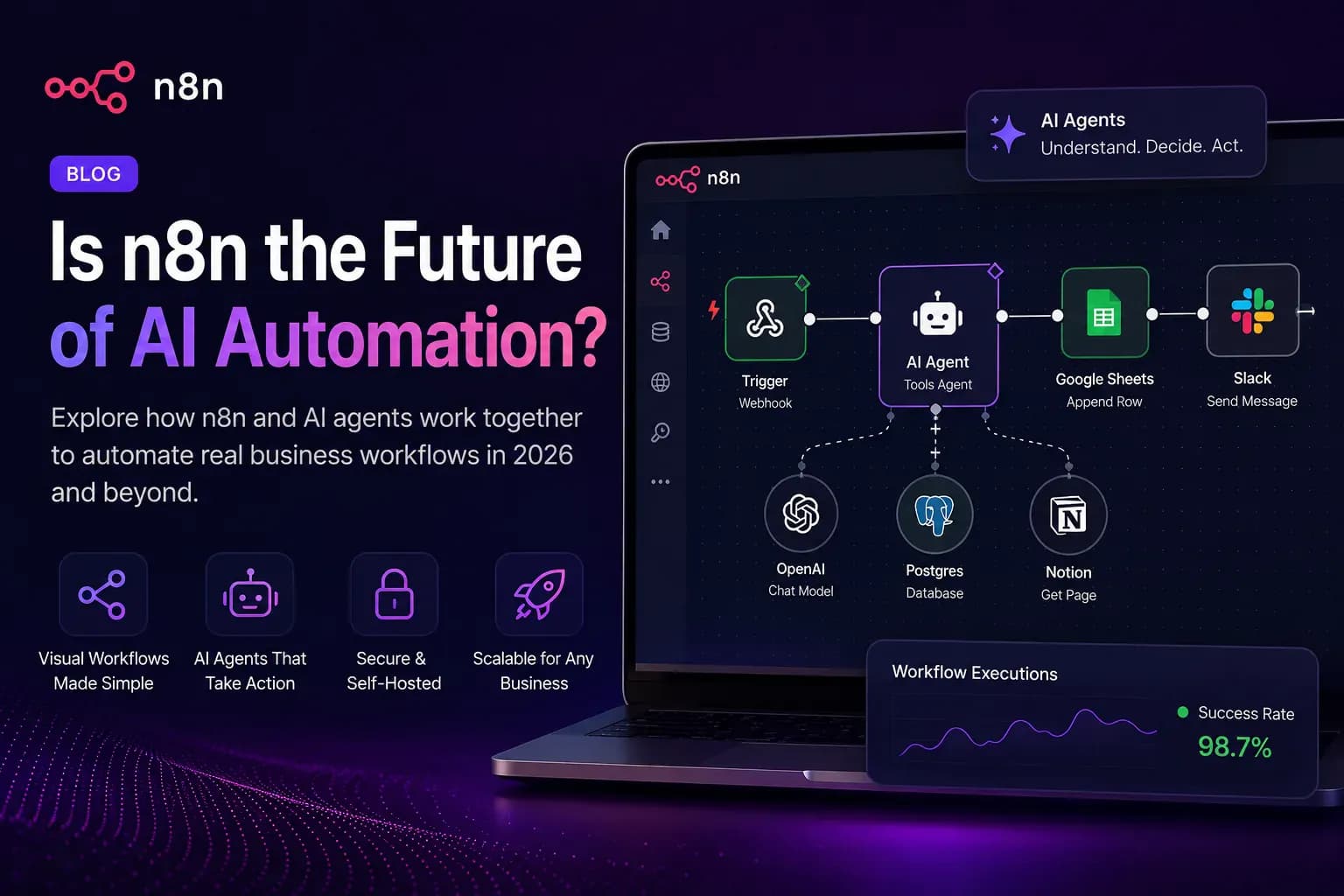
A few years ago, workflow automation usually meant moving data from one app to another. A form was submitted, a row appeared in a spreadsheet, and an email was sent. Useful—but predictable.
In 2026, businesses expect much more. They want automation that can read an email, understand what someone needs, check a CRM, search company knowledge, choose the next step, draft a response, update records, and involve a person only when a decision is important or risky.
That is where n8n AI automation is becoming increasingly relevant. n8n brings several parts of modern automation into one environment:
The important question is not whether AI can automate everything. It is whether businesses can combine AI with predictable workflows in a way that remains useful, secure, and reliable.
n8n is a workflow automation platform where users connect steps, called nodes, to build automated processes. A node may receive information from a form, call an API, update a database, send an email, run custom code, or connect with an AI model.
Traditional automation normally follows rules that are defined in advance. For example, when a new lead arrives, the workflow may validate the information, add the lead to a CRM, and notify a salesperson.
With n8n AI automation, the workflow can also understand unstructured information. AI can read a lead's message, identify what the business needs, summarize the request, extract useful details, or help decide which approved workflow path should run.
The strongest approach is to use AI only where language understanding or flexible judgment adds value, while keeping predictable business rules inside normal workflow logic.
n8n is getting attention because it is moving beyond basic app-to-app automation. AI-assisted workflow building, AI agents, human approval, guardrails, workflow evaluations, MCP connectivity, and enterprise controls are becoming more important parts of the platform.
One major change is AI-assisted workflow building. Users can describe an automation in natural language and receive help creating, editing, testing, and troubleshooting the workflow.
For example, a user could describe a process such as: When a new lead arrives, check the company, summarize its requirements, update the CRM, and notify sales.
AI can help build that workflow faster, but it still needs clear instructions. Businesses must define the trigger, expected result, connected systems, exceptions, permissions, and approval rules before the automation can be trusted in production.
A reliable n8n AI workflow usually combines AI with normal workflow logic instead of allowing an agent to control the entire process.
This hybrid structure is safer than giving an AI agent broad access to multiple systems and simply asking it to handle everything.
n8n AI agents are most useful when a process contains language, unstructured information, or small judgment calls but still has a clear goal and defined boundaries.
The goal is not to use AI in every step. AI should handle the parts where interpretation is useful, while fixed workflow logic handles the parts where the result must always follow a clear rule.
A successful demo does not automatically mean an AI workflow is ready for real business use. AI agents still have important limitations.
Traditional automation and AI agents solve different types of problems. Choosing the right approach depends on how predictable the task is.
For most production use cases, the hybrid model is the strongest option. Fixed workflow nodes can handle validation, routing, permissions, retries, and records. AI can handle classification, summarization, extraction, or bounded decisions. Humans can remain responsible for actions that are sensitive or difficult to reverse.
Creating an impressive AI automation demo is relatively easy. Making the workflow dependable after hundreds or thousands of real executions is much harder.
Recent research examining more than 6,000 public n8n agentic workflows found that AI was commonly combined with tools, routing, storage, communication systems, and sometimes human review. However, fallback paths, repair loops, failure-specific alerts, and approval gates were still relatively uncommon.
That creates a major gap between an interesting AI prototype and production-ready business automation.
n8n can be used through a managed cloud service or deployed on infrastructure controlled by your organization.
n8n Cloud is usually a better fit for teams that want faster setup, managed infrastructure, easier updates, and less operational work.
Self-hosted n8n can be useful when a business needs more control over infrastructure, networking, deployment, credentials, or data movement.
However, self-hosting should not automatically be treated as free or more secure. Your team becomes responsible for maintaining the environment.
The right choice depends on the team's technical capacity, security requirements, compliance needs, and desired level of infrastructure control.
An AI chatbot that only generates text creates one type of risk. An AI agent that can access databases, send emails, edit CRM records, call APIs, or change business data creates a much larger security responsibility.
AI agents should receive only the access they actually need to complete their task.
No one can predict the future of a software platform with certainty, but several trends already show where n8n and AI workflow automation are heading.
The future of automation will not depend only on making AI models smarter. Businesses will also need better ways to control, test, monitor, and govern what those models are allowed to do.
n8n is promising because it brings integrations, APIs, workflow logic, custom code, AI agents, human approval, and deployment control into one environment.
For smaller teams, this can reduce the need for several disconnected automation tools. For developers, it can speed up integrations and AI workflows while still allowing custom code. For larger organizations, the real value depends on governance, security, testing, and clear ownership.
The future of AI automation is unlikely to be a world where AI simply runs everything. A more practical model is hybrid automation.
n8n is well positioned for that model because it allows all three approaches to work together inside one workflow.
The best question to ask is not, "Where can we add an AI agent?" Instead, ask, "Which part of our process is slow, repetitive, unstructured, or difficult to manage—and what is the simplest reliable way to improve it?"
The best automation is not the one with the most AI. It is the one that produces the right result safely, consistently, and at scale.
Trust is the real currency of fintech. Learn how thoughtful UX, transparency, security cues, and clear product design help users feel confident with every financial interaction.
Design handoff is where product quality often starts to drift. Learn how design tokens, reusable components, developer collaboration, and visual testing keep production UI aligned with Figma.
Adding AI is easy. Building AI features that solve real user problems is harder. Learn how to design useful, reliable, transparent, and human-centered AI product experiences.
Fast websites do not happen by accident. Learn how practical performance budgets, real-device testing, Core Web Vitals, and automated CI checks keep web performance under control.